About AI from my point of view...
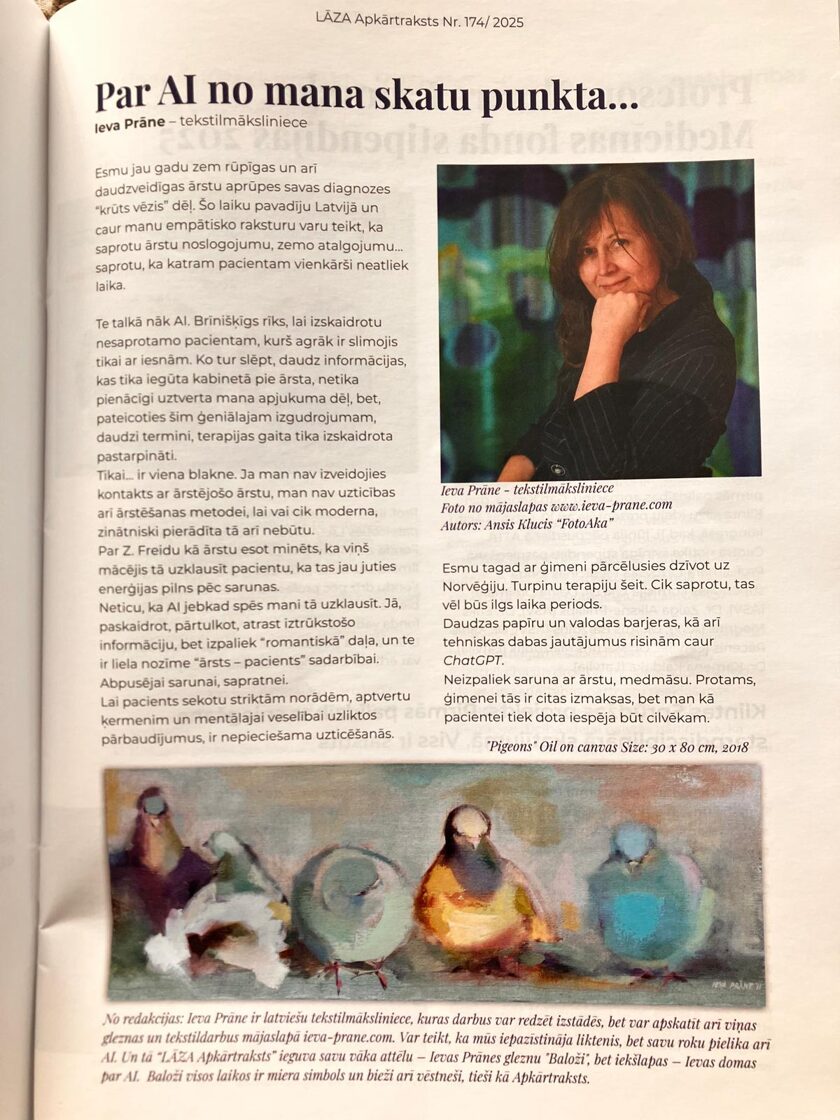
I have been under careful and diverse medical care for a year now due to my diagnosis of breast cancer. I have spent this time in Latvia, and thanks to my empathetic personality, I can say that I am aware of the doctors' workload and low salaries... I understand that there is simply not enough time for each patient.
This is where AI comes in. It is a wonderful tool for explaining the incomprehensible to a patient who has previously only suffered from common colds. To be honest, a lot of the information I received at the doctor's office was not properly absorbed due to my confusion, but thanks to this ingenious invention, many terms and the course of therapy were explained indirectly.
There is just one drawback. If I have not established contact with the treating physician, I do not trust the treatment method, no matter how modern and scientifically proven it may be.
It has been said about S. Freud as a physician that he knew how to listen to his patients in such a way that they felt full of energy.
I don't believe that AI will ever be able to listen to me like that. Yes, it can explain, translate, find missing information, but the "romantic" part is missing - and this is where the "doctor-patient" relationship is very important. Mutual conversation, understanding. For a patient to follow strict instructions and understand the challenges to their physical and mental health, trust is necessary.
I have now moved to Norway with my family. I am continuing my therapy there, and as far as I understand, it will be a long process. We resolve many paperwork, language barrier, and technical issues through ChatGPT.
There are also conversations with the doctor and nurse—of course, these are additional costs, but as a patient, I am given the opportunity to be human.
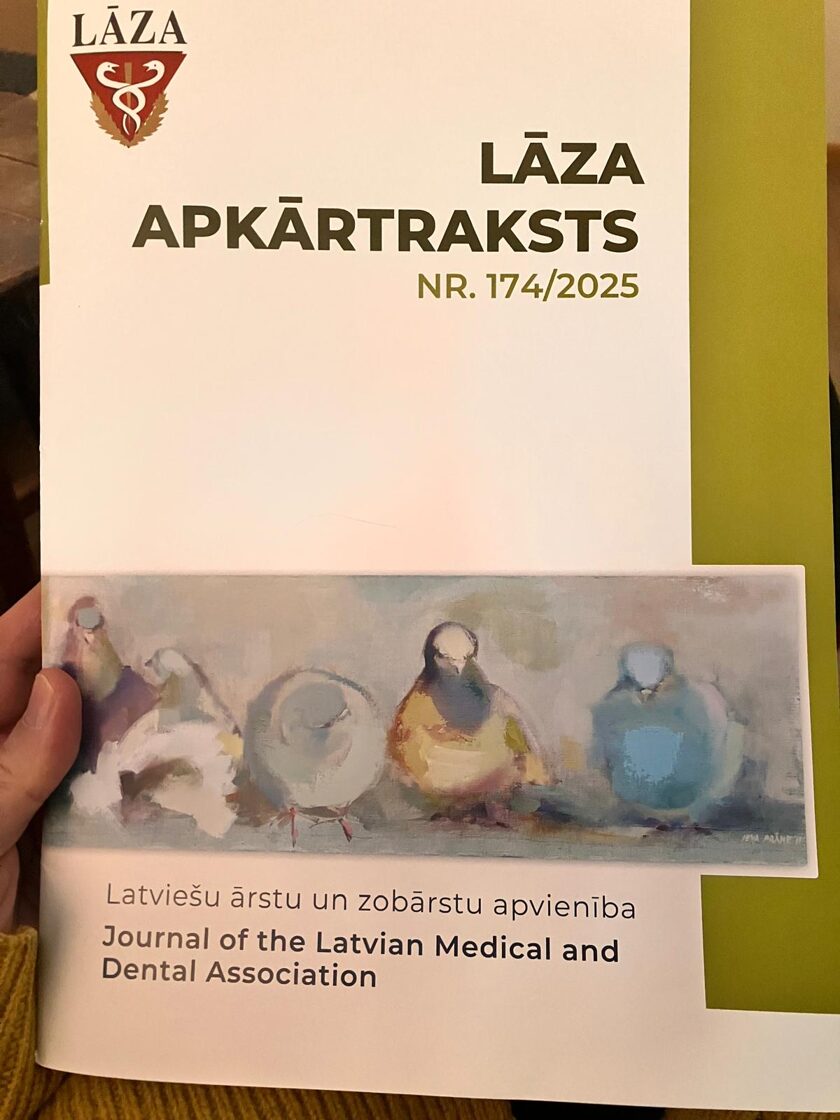
Transcript from the Journal of the Latvian Medical and Dental Association Nr.174/2025
Depict what you see
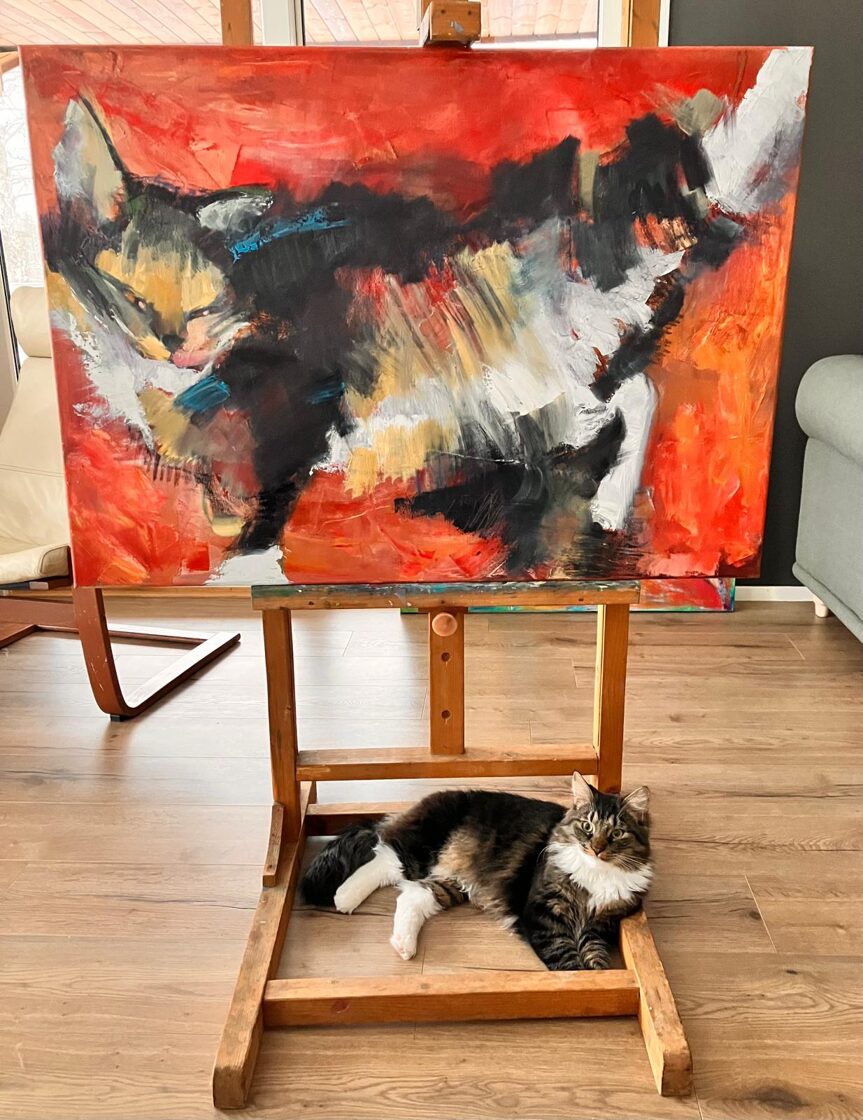
But then there can also be an idea for a portrait and begin: is it similar or maybe not at all... I want to depict what I see – deeper than the surface. There may be a photographic resemblance, one can depict facial expressions, emotions: joy, sadness, anger... Delving deeper, what I want to say is: can you depict personality, temperament? My lively and fluffy pet, Žanītis (whose passport name is Juan Reno, yes, like the French actor ;)), is, of course, a very grateful model, because he will never express objections or destructive criticism, and most importantly, he will never take offense. Full of mischief, nimble as a gazelle, and at the same time my little daily delight, my darling. How can all of this fit into one personality? And how to depict a cat without banality, especially since cats have been painted so many times – I mean in the context of culture and art history. And then you "turn on" a different context, meaning, motivation – Carelessness. Sometimes it's enough to set yourself a challenge: depict what you see! Train your modes of expression, your narrative style. Because one of the most painful experiences is when you are not heard. When you have no "voice." Then it feels like you don't exist at all. To maintain meaning, seemingly doing something insignificant. To see potential, instead of just what already exists—that was my goal this time.
ARTAPESTRY7
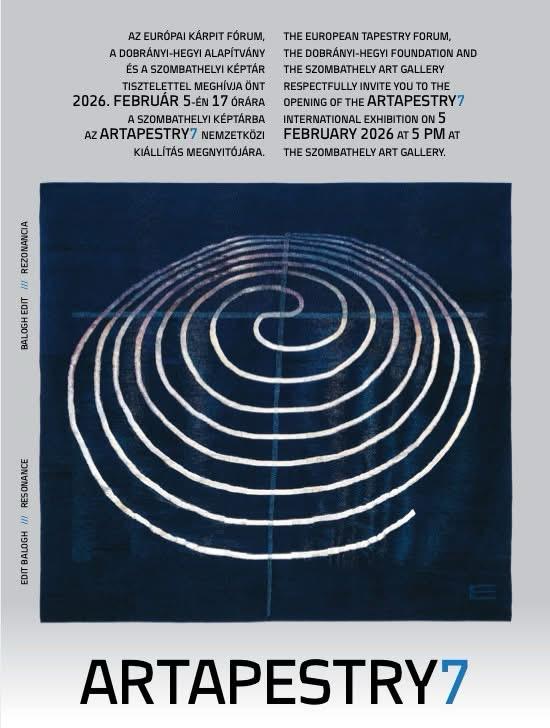
At the beginning of February, in Szombathelyi Képtár (Hungary) opened the last and final exhibition of the Artapestry7 triennial, organized by the European Tapestry Forum (ETF). It features 37 tapestries by 34 artists from 15 European countries.
It has been a great honor for me to participate in the triennial exhibitions in four countries with my tapestry "In the Gardens of Light." It is fascinating to see how differently the same work can be exhibited (read: told as if it were the same story). I have always said that space and lighting are an important part of the tapestry's "story" – it can simply be shown, but it can also be highlighted and "celebrated." In these group exhibitions, it has always been intriguing to see the big picture, the seemingly unified genre of "woven tapestry" by different authors, and yet such different styles, choice of materials and, ultimately, the message itself. The images in tapestries can only be sensed; they reveal themselves to the viewer through the unsaid, each so individual, personal, and yet inseparably shared. Some artists create abstract compositions saturated with colour fields and symbols, while others create images or information-rich works. For some artists, large formats are too small, while others experience cosmic eternity in miniature. It is important that such exhibitions are organized.
Special thanks to Anet Bursgaard and Thomas Cronenberg for their work! There were four textile artists from Latvia – Dace Grīnberga, Hele, Lija Rage, and Ieva Prāne. The exhibitions have been traveling since 2024 and have been displayed at the Deutsches Textielmuseum Krefeld (Germany), KunstCentret Silkeborg Bad (Denmark), Janinos Monkutės-Marks Museum-Gallery, Kedainiai (Lithuania) and now at the Szombathelyi Képtár Museum (Hungary).
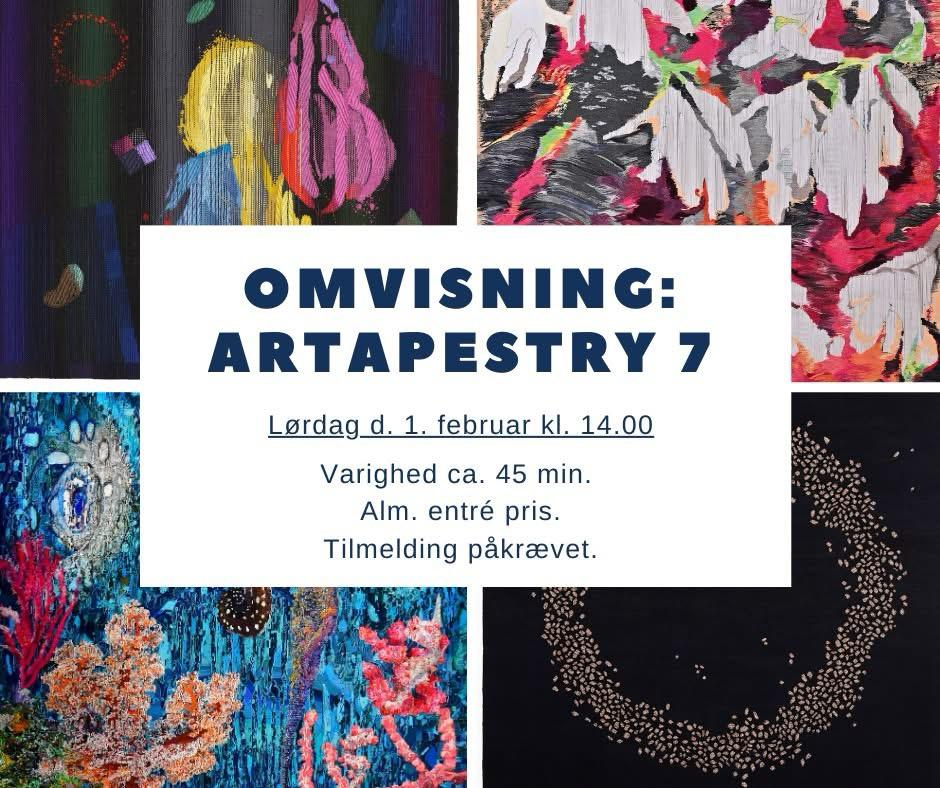
The Exhibition 2026 Open in the Szombathely Image Gallery until March 8.
The calmness and aesthetics of the process
The statement is undoubtedly equivalent to a tapestry, which creation is a slow and labour-intensive artistic process. So often in the art world it has stood in contrast to the making of many other genres of artworks, where quantity and speed of creation have frequently been decisive. This was perhaps dictated by the gallerist… Now, when anything visual can be generated within seconds using AI, the questions are different: Is art real? Can it be trusted…?
I am clearly aware that in order to create a work of art, it must first be born internally. Without haste, with commitment and ambition (in the best sense of the word ;)) — by creating sketches, painting and searching for colour combinations, weighing composition and texture, the interaction of surfaces and materials. Understanding that every “small detail” matters. Just like watching professionals dance ballet — we do not want to see their sweat, but rather how beautifully they live and die while dancing. That is what moves us, what emotionally charges us.
The calmness and aesthetics of the process. A story that is woven, highlights different surface textures, thin layers that contrast with thick and brutal roughness. The variety of textile fibers available today is an astonishing resource for depicting softness and fluffiness or, on the contrary, metallic coolness, shine and/or shimmer. It does not matter how long a single tapestry takes to create; what matters is whether the viewer would want to devote the time, to engage deeply and “dive” into the depth of the tapestry. Yes, this requires calmness — the new luxury.
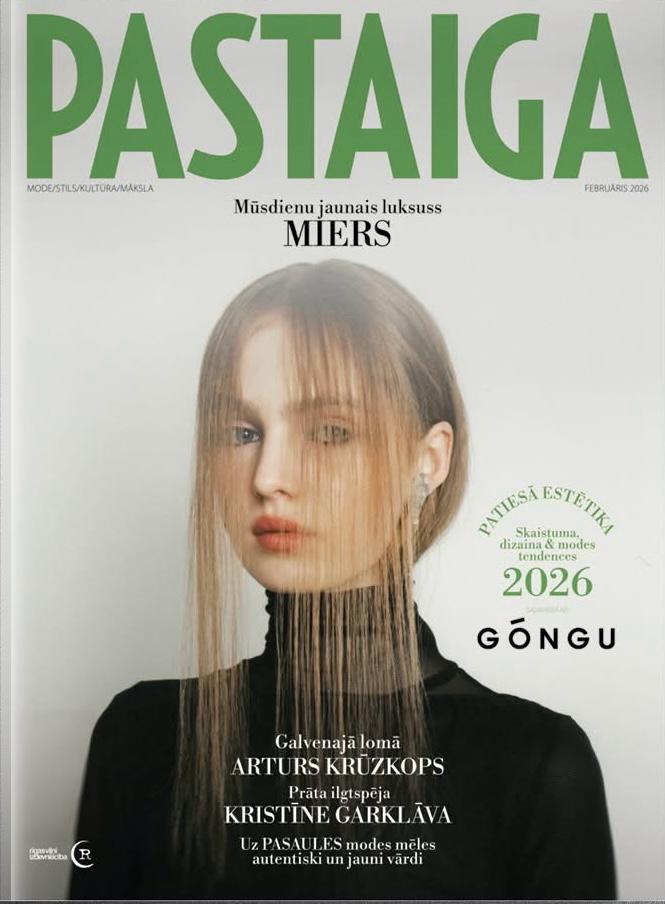
"Pastaiga" wrote that (and there is nothing to add or take away): “…about aesthetics without noise, about choices with meaning and sensations that remain. About fashion, design and beauty that are not loud, but precise. About culture, people and conversations that make you stop.”
So, the quote is about textile art and the tapestry.
Why tapestry?
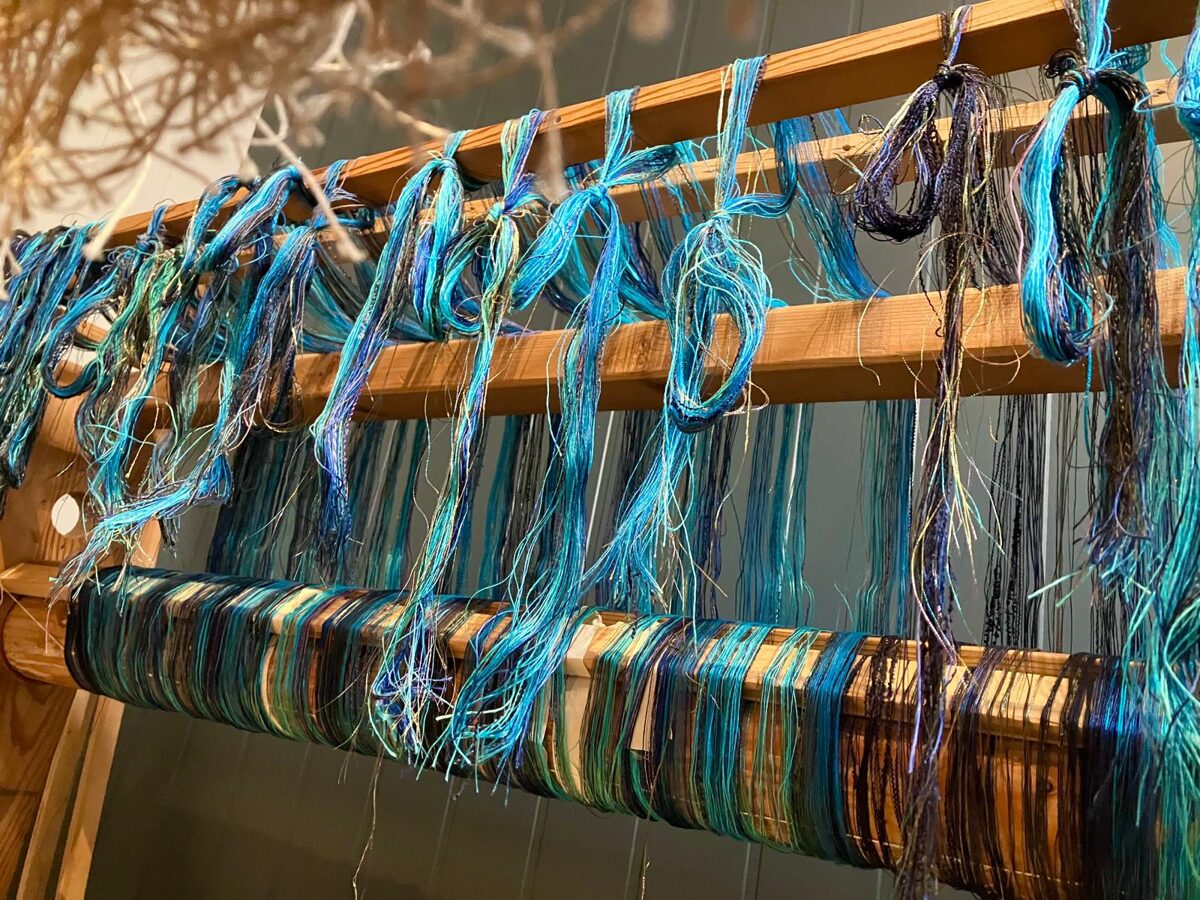
Tapestry weaving is, first and foremost, a painting. A painting in material, where what matters is not only composition and color, but also surface and texture. The method, the weave—how the thread is woven into the warp—determines whether the tapestry will be dense or whether it will interact with rays of light in a space and create yet another mediated image through the interplay of light and shadow. Drawing and painting together with virtuosity and a feeling of materiality. Everything in one place, everything as a single whole.
Originally, in the 14th century, tapestries were woven in manufactories by weavers—masters of their craft. There was an artist’s sketch, which was then realized into material. The idea and the execution were separate. The phenomenal story of Baltic textile artists begins in Soviet times. Yes, harsh times for art and culture in general, but not for tapestry. Large monumental themes could be realized by the artist in material starting already from the concept and the sketch. Yes—one person as an orchestra. ;))
Sometimes—no, always—when seeing the result of such time-consuming work, I am left breathless with amazement, because in textile art there is always room for the unanticipated, for a mythical kind of wonder.